Electrostimulation & Biological Frequencies
A comprehensive, evidence-based overview of how electric fields, radiofrequency, ultrasound, and related technologies interact with cancer cells, viruses, bacteria, parasites, and fungi — separating verified science from popular myths.
What Science Actually Shows
Three distinct lines of research explore the interaction between electrical stimulation and viruses \u2014 each with very different scopes and limitations.
Direct Viral Inhibition by Electrical Pulses (In Vitro)
A 2023 study demonstrated that direct electrical pulses can reduce the infectivity of human coronavirus 229E.
- Current: 25 mA
- Type: DC pulses
- Frequencies: 2 Hz or 20 Hz
- Result: Strong inhibition of viral activity
These tests were performed on the virus itself, in a laboratory dish — not in a living organism.
Electrostimulation to Activate Antiviral Cells (Advanced Biotechnology)
Another line of research explores genetically modified cells that, upon receiving an electrical signal, produce interferon-β — a powerful antiviral protein.
- Objective: create a universal electrically activated cell therapy
- Validated against SARS-CoV-2 in cell culture
This is not electrostimulation applied to the body, but a bioengineering technology.
Transcranial Electrostimulation (tES): Not Antiviral
Some research investigates electrical brain stimulation to help manage post-COVID fatigue, cognitive impairment, and emotional distress.
- Target: neurological symptoms, not the virus itself
- Mechanism: neuromodulation
This does not kill the virus but may help manage certain symptoms.
Biological Mechanisms of Action
Understanding the precise physical and biological mechanisms through which electrical, electromagnetic, and acoustic energy interact with living cells and microorganisms.
Electroporation
Membrane Disruption via Electric Pulses
Short, high-voltage electrical pulses create transient or permanent pores in cell membranes. At lower voltages (reversible), this allows drug delivery into cells. At higher voltages (irreversible), it destroys cells by disrupting membrane integrity.
Frequency: 1–10 kHz | Field: 200–3000 V/cm | Pulse: 1–100 µs
Applications
Radiofrequency Hyperthermia
Controlled Tissue Heating
Radiofrequency electromagnetic waves penetrate tissue and cause molecular vibration, raising temperature to 41–45°C. Cancer cells are more heat-sensitive than normal cells due to their disorganized vasculature and inability to dissipate heat efficiently.
Frequency: 13–40 MHz | Power: 50–1000 W | Temp: 41–45°C
Applications
Acoustic Cavitation
Ultrasound-Induced Microbubble Collapse
Ultrasonic waves create microscopic bubbles in liquid media that rapidly expand and collapse (cavitation). This violent implosion generates extreme local temperatures (~5000°C), pressures (~1000 atm), and free radicals that destroy nearby microorganisms.
Frequency: 20 kHz–3 MHz | Intensity: 0.5–10 W/cm²
Applications
Tumor Treating Fields (TTFields)
Alternating Fields Disrupting Mitosis
Low-intensity alternating electric fields at specific frequencies (100–300 kHz) interfere with the formation of the mitotic spindle during cell division. Dipolar molecules like tubulin are forced to align with the field, preventing proper chromosome separation.
Frequency: 100–300 kHz | Intensity: 1–3 V/cm | Duration: 18+ hrs/day
Applications
Cold Atmospheric Plasma
Ionized Gas at Room Temperature
Cold plasma generated by RF or microwave excitation produces a mixture of reactive oxygen/nitrogen species (RONS), UV photons, and charged particles at near-body temperature. This cocktail of agents damages microbial DNA, oxidizes proteins, and disrupts biofilms.
RF: 13.56 MHz or MW: 2.45 GHz | Gas: He/Ar/Air | Temp: <40°C
Applications
Magnetic Nanoparticle Hyperthermia
Targeted Heating via Alternating Magnetic Fields
Iron oxide nanoparticles injected into tumors generate heat when exposed to alternating magnetic fields. The nanoparticles convert electromagnetic energy into localized thermal energy through Néel and Brownian relaxation, selectively destroying cancer cells.
Frequency: 100–500 kHz | Field: 5–25 kA/m | Nanoparticle: Fe₃O₄
Applications
Key Clinical Studies & Research
A curated selection of landmark published studies exploring electrostimulation and electromagnetic frequency-based approaches across oncology, virology, microbiology, and neurology.
Tumor Treating Fields (TTFields) for Newly Diagnosed Glioblastoma
Stupp R, Taillibert S, et al.
JAMA – Journal of the American Medical Association
The landmark EF-14 randomized clinical trial demonstrated that adding TTFields (200 kHz alternating electric fields) to maintenance temozolomide chemotherapy significantly extended survival in patients with newly diagnosed glioblastoma.
Irreversible Electroporation for Locally Advanced Pancreatic Cancer
Ruarus AH, Vroomen LG, et al.
Annals of Surgical Oncology
This study evaluated irreversible electroporation (IRE) as a treatment for locally advanced pancreatic cancer that could not be surgically removed, demonstrating that high-voltage ultrashort electrical pulses could ablate tumor tissue without damaging surrounding blood vessels.
Direct Electrical Inhibition of Human Coronavirus 229E
Komiya T, Fukai T, et al.
Scientific Reports (Nature)
Researchers demonstrated that direct current (DC) electrical pulses at low frequencies could significantly reduce the infectivity of human coronavirus 229E in laboratory conditions, opening new avenues for non-pharmaceutical antiviral approaches.
Electrically Controlled Interferon-β Production from Engineered Cells
Krawczyk K, Xue S, et al.
Nature Metabolism
This pioneering bioengineering study created designer cells equipped with electrogenetic interfaces that produce interferon-β upon electrical stimulation, offering a potential universal antiviral defense system that can be activated on demand.
Pulsed Electric Fields for Bacterial Biofilm Eradication
Kovalova Z, Leroy-Freitas D, et al.
Bioelectrochemistry
This research demonstrated that pulsed electric fields (PEF) can effectively disrupt and eradicate bacterial biofilms, which are notoriously resistant to antibiotics. The study showed particular promise for treating chronic wound infections and medical device contamination.
Transcranial Direct Current Stimulation for Post-COVID Cognitive Dysfunction
Pilloni G, Bikson M, et al.
Brain Stimulation
A clinical study evaluating transcranial direct current stimulation (tDCS) as a treatment for persistent cognitive symptoms following COVID-19 infection, known as "brain fog". Results showed measurable improvements in processing speed and attention.
RF Hyperthermia Combined with Chemotherapy for Deep-Seated Tumors
Issels RD, Lindner LH, et al.
JAMA Oncology
A phase III randomized trial demonstrated that adding regional hyperthermia (13.56 MHz radiofrequency) to systemic chemotherapy significantly improved outcomes for patients with locally advanced soft-tissue sarcomas.
High-Intensity Focused Ultrasound (HIFU) for Prostate Cancer
Abreu AL, Gill IS, et al.
European Urology
This large prospective study evaluated focal HIFU therapy as a tissue-preserving alternative to radical prostatectomy for localized prostate cancer, showing excellent cancer control with minimal impact on quality of life.
Cold Atmospheric Plasma for Wound Disinfection and Healing
Bernhardt T, Semmler ML, et al.
Oxidative Medicine and Cellular Longevity
This comprehensive review analyzed the use of cold atmospheric plasma (CAP) — ionized gas at near-body temperature generated by RF or microwave excitation — for wound disinfection, demonstrating broad-spectrum antimicrobial activity.
Electroporation-Based Antiparasitic Treatment in Animal Models
Martínez-Torres AC, et al.
PLOS Neglected Tropical Diseases
An innovative study exploring the use of pulsed electric fields combined with antiparasitic drugs to treat leishmaniasis in animal models, showing that electroporation dramatically increased drug uptake into parasite-infected cells.
Myths vs. Future Capabilities
Separating unfounded claims from scientifically plausible future developments.
What Does Not Exist
Despite popular myths
- No evidence that an external electrical device (TENS, EMS, homemade electrodes) kills a virus inside the body.
- No "magic" antiviral frequency usable on humans — viruses are too small to have exploitable resonance frequencies.
- No method for internally electrocuting a virus without destroying human tissue. The currents required to disrupt a virus would destroy human cells long before.
- Rife machine frequencies have no peer-reviewed scientific evidence supporting antiviral or anticancer claims.
- Commercial "frequency healing" devices operate at power levels 6–9 orders of magnitude below research equipment.
- No frequency-specific effect per pathogen species — resonance depends on size, shape, density, and environment, not species identity.
What Is Plausible in the Future
Scientifically supported directions
- Self-disinfecting surfaces using micro-currents (already in development for hospital settings).
- Electrically activated cell therapies producing antiviral proteins on demand (validated in preclinical studies).
- External devices to reduce viral load in the air or on objects using cold plasma technology.
- AI-optimized treatment field planning for personalized cancer TTFields therapy.
- Implantable bioelectronic devices combining electrostimulation with drug delivery.
- Sonodynamic therapy combining ultrasound with sonosensitizers for deep tumor treatment.
Biological Safety Boundaries
Understanding why electrostimulation cannot simply be "turned up" to kill pathogens inside the human body — the physical and biological constraints that define what is safe and what is not.
Current Density Limits
The human body can safely tolerate very limited electrical current. Sensory perception begins at ~1 mA, pain at ~5 mA, and involuntary muscle contraction at ~15 mA. The currents needed to disrupt viral particles (~25 mA concentrated) would cause severe tissue damage if applied internally.
Threshold
< 1 mA (safe perception) → 25+ mA (viral inhibition threshold)
Key Implication
The 25× gap between safe body current and viral inhibition current makes direct in-body application dangerous with current technology.
Thermal Damage Boundaries
RF hyperthermia raises tissue temperature to 41–45°C for therapeutic effect. Above 45°C, protein denaturation and cell death occur rapidly. Normal body temperature (37°C) provides only a 4–8°C therapeutic window before irreversible damage.
Threshold
41–43°C (therapeutic) → 45°C+ (tissue necrosis)
Key Implication
Precision temperature control within a narrow 4°C window is essential to avoid burning healthy tissue while damaging target cells.
Cardiac Safety Considerations
Electrical currents passing through the thorax can disrupt cardiac rhythm. Ventricular fibrillation can occur at currents as low as 100 mA AC through the heart. All electrostimulation devices must account for current pathways to avoid cardiac interference.
Threshold
100 mA AC through heart → ventricular fibrillation
Key Implication
Any therapeutic electrical device must ensure current pathways avoid the heart, limiting treatment locations and configurations.
Neurological Safety
Transcranial stimulation (tDCS/tACS) uses currents of 1–2 mA, well below the threshold for tissue damage but sufficient to modulate neural activity. Higher currents risk seizures, and effects on developing brains are not fully understood.
Threshold
1–2 mA (therapeutic tDCS) → 5+ mA (risk of seizure)
Key Implication
Neuromodulation requires precise dosing and is contraindicated in patients with epilepsy, metallic implants, or cardiac pacemakers.
Frequency-Dependent Tissue Penetration
Electromagnetic waves penetrate tissue differently based on frequency. Low frequencies (kHz) penetrate deep but lack targeting precision. High frequencies (GHz) are absorbed superficially. This creates a fundamental tradeoff between depth and precision.
Threshold
kHz: deep penetration → GHz: superficial absorption (<cm)
Key Implication
No single frequency can effectively target deep infections while sparing surrounding tissue — different depths require different approaches.
Why "Frequency Healing" Devices Are Dangerous
Commercial devices claiming to use specific frequencies to "kill" pathogens (often based on debunked Rife machine concepts) operate at levels too low to affect microorganisms but may delay patients from seeking proven medical treatment.
Threshold
Commercial devices: ~µW → Research-level effects: 10–1000 W
Key Implication
The power gap between commercial devices and research equipment is 6–9 orders of magnitude. Consumer devices cannot replicate lab results.
Medical Disclaimer
This website is a scientific reference compilation. It is not medical advice. The technologies described are at various stages of research and clinical validation. No commercial device currently available can replicate the effects observed in laboratory studies. Always consult qualified healthcare professionals before considering any electrostimulation-based treatment.
Research Timeline & Milestones
Six decades of scientific progress — from the first observation of electroporation to FDA-approved cancer treatments and beyond.
Electroporation Discovery
Stämpfli first observed that electric pulses could reversibly permeabilize cell membranes, laying the groundwork for electroporation science.
Gene Electrotransfer Demonstrated
Neumann et al. demonstrated that electric field pulses could introduce foreign DNA into mammalian cells, revolutionizing molecular biology.
First Electrochemotherapy
Mir et al. performed the first clinical electrochemotherapy, combining electroporation with bleomycin to treat head and neck tumors.
Irreversible Electroporation (IRE)
Davalos, Mir, and Rubinsky introduced IRE as a novel non-thermal tissue ablation technique, specifically targeting cancer cells.
TTFields FDA Approval
The FDA approved the Optune device (TTFields) for recurrent glioblastoma, marking the first approval of tumor-treating electric fields.
TTFields for Newly Diagnosed GBM
The EF-14 trial showed significant survival benefit of TTFields for newly diagnosed glioblastoma, leading to expanded FDA approval.
RF Hyperthermia Phase III Results
The EORTC 62961 trial confirmed that regional hyperthermia combined with chemotherapy significantly improves outcomes for soft-tissue sarcomas.
TTFields for Mesothelioma
FDA approved TTFields (NovoTTF-100L) for malignant pleural mesothelioma, the second cancer type treated with electric fields.
Electrogenetic Antiviral Cells
Researchers created designer cells that produce interferon-β on electrical command, demonstrating a new paradigm in electro-bioengineering.
Direct Electrical Viral Inhibition
DC pulses shown to inhibit human coronavirus infectivity in vitro, opening new avenues for non-pharmaceutical antiviral approaches.
TTFields Lung Cancer Trials
Phase III trials (LUNAR) demonstrated TTFields efficacy in non-small cell lung cancer, potentially expanding approvals to a third major cancer type.
Next Frontiers
Ongoing research into implantable electrostimulation devices, electrically activated cell therapies, AI-optimized treatment fields, and bioelectric wound healing.
Research Frequency Database
102 documented research entries across 6 categories \u2014 electric fields, RF, microwaves, ultrasound, UV, and plasma technologies.
| ID | Technology | Target / Tissue | Frequency | Typical Parameters | Primary Effect | Context |
|---|---|---|---|---|---|---|
| C1 | TTFields | Glioblastoma | 100 kHz | 1–3 V/cm | Mitosis inhibition | Clinical |
| C2 | TTFields | Mesothelioma | 150 kHz | 1–3 V/cm | Mitosis inhibition | Clinical |
| C3 | TTFields | Ovarian cancer | 200 kHz | 1–3 V/cm | Division inhibition | Trials |
| C4 | TTFields | Pancreatic cancer | 150–200 kHz | 1–3 V/cm | Microtubule disruption | Trials |
| C5 | AC electric fields | Various cell lines | 50–300 kHz | 1–5 V/cm | Cell cycle disruption | In vitro |
| C6 | IRE (irreversible electroporation) | Liver tumors | 1 kHz | 1500–3000 V/cm, µs pulses | Membrane rupture | Clinical |
| C7 | IRE | Pancreas | 1–5 kHz | 1000–2500 V/cm | Non-thermal ablation | Clinical |
| C8 | IRE | Prostate | 1–2 kHz | 1500–2000 V/cm | Targeted destruction | Clinical |
| C9 | Reversible electroporation | Skin tumors | 1–10 kHz | 200–800 V/cm | Permeabilization for chemo | Clinical |
| C10 | RF hyperthermia | Deep tumors | 13.56 MHz | 100–500 W | Heating 41–45 °C | Clinical |
| C11 | RF hyperthermia | Pelvis | 27.12 MHz | 100–500 W | Radio/chemo sensitization | Clinical |
| C12 | RF hyperthermia | Superficial tumors | 40.68 MHz | 50–300 W | Local hyperthermia | Clinical |
| C13 | RF multi-antenna | Brain (models) | 100–1000 MHz | Shaped fields | Thermal focusing | Modeling |
| C14 | Microwaves | Breast | 915 MHz | 10–100 W | Hyperthermia | Clinical |
| C15 | Microwaves | Superficial tumors | 2.45 GHz | 10–60 W | Thermal destruction | Clinical |
| C16 | Microwaves | Liver | 2.45 GHz | 60–150 W | Ablation | Clinical |
| C17 | Microwaves | Lung | 915 MHz | 40–100 W | Ablation | Clinical |
| C18 | HIFU | Liver tumors | 0.8–1.5 MHz | >1000 W/cm² | Thermal ablation | Clinical |
| C19 | HIFU | Uterus (fibroids) | 0.8–1.2 MHz | >1000 W/cm² | Coagulative necrosis | Clinical |
| C20 | HIFU | Prostate | 0.8–3 MHz | Focused | Targeted destruction | Clinical |
| C21 | Low-intensity ultrasound | Cancer cell lines | 20 kHz | 1–5 W/cm² | Cavitation, oxidative stress | In vitro |
| C22 | Low-intensity ultrasound | Cancer cell lines | 40 kHz | 1–5 W/cm² | Synergy with chemo | In vitro |
| C23 | Therapeutic ultrasound | Superficial tumors | 1 MHz | 0.5–3 W/cm² | Mild hyperthermia | Preclinical |
| C24 | Pulsed ultrasound | Brain (BBB) | 0.2–0.7 MHz | Low intensity | BBB opening | Preclinical |
| C25 | RF + nanoparticles | Tumors | 13–40 MHz | 10–100 W | Selective nano-heating | Research |
| C26 | Microwaves + contrast agents | Tumors | 2.45 GHz | 10–80 W | Targeted hyperthermia | Research |
| C27 | Alternating magnetic fields | Nano-Fe | 100–500 kHz | kA/m | Magnetic hyperthermia | Preclinical |
| C28 | Whole-body RF | Oncology | 13.56 MHz | 200–1000 W | Systemic hyperthermia | Research |
| C29 | Localized RF | Head/neck tumors | 70–120 MHz | Shaped fields | Controlled heating | Treatment planning |
| C30 | Modulated ultrasound | Tumors | 0.5–1.5 MHz | Amplitude modulation | Radiosensitization | Preclinical |
| C31 | TTFields | Non-small cell lung cancer | 150 kHz | 1–3 V/cm | Mitosis inhibition | Phase III (LUNAR) |
| C32 | TTFields + immunotherapy | Various solid tumors | 100–300 kHz | 1–3 V/cm + checkpoint inhibitors | Enhanced immune response | Phase II |
| C33 | Nanosecond PEF (nsPEF) | Melanoma | ns pulses, 1–10 Hz | 10–50 kV/cm, 10–300 ns | Apoptosis induction | Preclinical |
| C34 | Nanosecond PEF | Hepatocellular carcinoma | ns pulses | 20–40 kV/cm, 100 ns | Calcium-mediated cell death | In vitro |
| C35 | Calcium electroporation | Cutaneous metastases | 1 kHz | 800–1200 V/cm + CaCl₂ | Calcium overload necrosis | Clinical trials |
| C36 | Sonodynamic therapy (SDT) | Glioma | 1–3 MHz | 0.5–2 W/cm² + sonosensitizer | ROS generation | Preclinical |
| C37 | Microwave ablation | Renal tumors | 2.45 GHz | 40–100 W | Thermal ablation | Clinical |
| C38 | Low-intensity pulsed US | Bone metastases | 1.5 MHz | 30 mW/cm², 20 min/day | Anti-tumor + bone healing | Preclinical |
Research-Grade Electrostimulation Platform
A conceptual multi-modal medical device designed to consolidate the key electrostimulation technologies documented in our research database into a single, programmable platform for laboratory and clinical research.
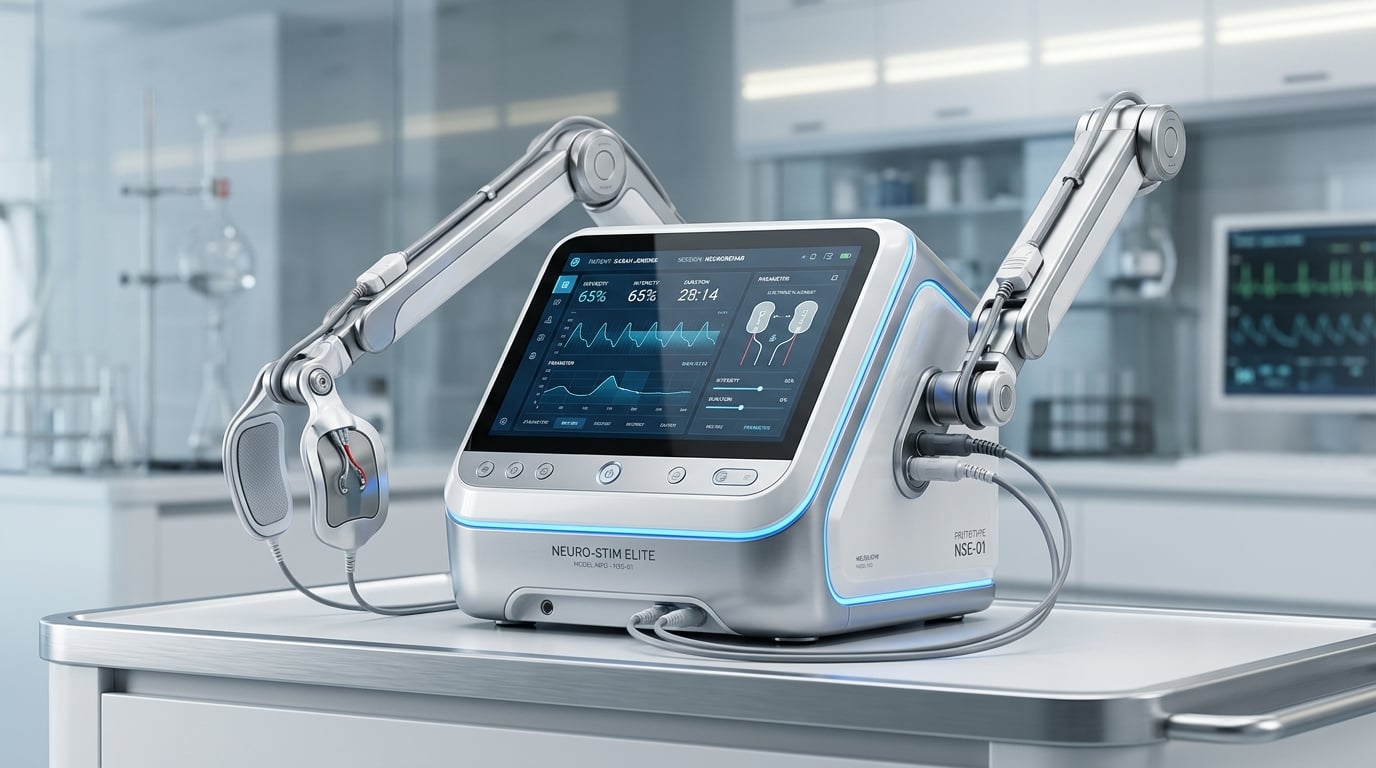
ElectroScience MX-1
Multi-Modal Electrostimulation Research Platform
Technical Specifications
Frequency Range
0.1 Hz – 10 MHz
Covers full bioelectric spectrum from sub-Hz to RF
Output Modes
6 Programmable
DC, AC, pulsed, burst, swept, and modulated waveforms
Current Control
0.01 – 250 mA
Precision micro-current to therapeutic ranges
Safety System
Triple Redundant
Real-time impedance monitoring, auto-shutoff, thermal guard
Field Intensity
Up to 200 V/cm
Adjustable for electroporation, TTFields, and sub-threshold
Interface
10" Touchscreen
Real-time waveform display, protocol library, data logging
Platform Capabilities
- Multi-frequency TTFields delivery (100–300 kHz) for research applications
- Reversible & irreversible electroporation protocols with µs precision
- RF hyperthermia mode with integrated temperature feedback
- Pulsed electric field (PEF) generation for microbial research
- Cold atmospheric plasma driver interface for plasma jet coupling
- Impedance spectroscopy for real-time tissue characterization
- Protocol recording & export for reproducible experimental design
- Multi-electrode array support (up to 8 independent channels)
Research Applications
Oncology Research
TTFields simulation, electroporation-assisted drug delivery, and RF hyperthermia protocols for in vitro / in vivo cancer studies.
Microbiology
PEF-based pathogen inactivation, biofilm disruption, and antimicrobial frequency scanning for bacteria, viruses, and fungi.
Neuroscience
Transcranial and peripheral electrostimulation with customizable waveforms for neuromodulation and pain management research.
Bioengineering
Electrochemical cell stimulation, wound healing acceleration, and tissue engineering applications with precise current control.
Prototype Disclaimer
The ElectroScience MX-1 is a conceptual research platform. It is not a certified medical device and is not intended for clinical use on patients. This prototype concept is designed exclusively for controlled laboratory research and educational demonstration purposes. Any therapeutic applications would require extensive clinical trials and regulatory approval.